What is EMDR Therapy? An Evidence-Based Guide for Clients in Ontario

Curious about EMDR in Ontario but terrified that it’s going to be “too much”?
Most of my clients come to me because they are just done with feeling overwhelmed. You know that feeling where your brain says, “I’m safe,” but your body is still stuck in fight-or-flight mode?
Yeah, me too. It’s exhausting to live in that gap where your nervous system hasn't quite caught up to your present reality.
If you’ve been putting off therapy because you’re scared of “opening the box” and being flooded by all of the hard emotions, I hear you. But here is the shift: EMDR is one of the most effective forms of virtual trauma therapy in Ontario. It isn’t about re-traumatizing you or forcing you to relive the past. It’s about finally processing the experiences that are keeping you stuck, so your body can finally feel as safe as your brain knows you are.
If you’re interested in other trauma-informed therapy approaches, you can also learn more about trauma therapy at Anchor Point Therapy.
TL;DR: EMDR Therapy at a Glance
EMDR (Eye Movement Desensitization and Reprocessing) is a clinically validated therapy that helps the brain "file away" traumatic memories that are currently causing distress. By using Bilateral Stimulation (like guided eye movements or rhythmic tapping), we reduce the emotional charge of past events.
As a Registered Social Worker (MSW, RSW) in Ontario, I use EMDR to help clients navigate PTSD, birth trauma, high-functioning anxiety and anything that is causing you to feel stuck. It is recognized by the World Health Organization (WHO) and is covered by most Ontario workplace insurance plans.
Key Takeaways:
Clinically Validated: Research shows EMDR is an efficient way to process trauma, often working faster than traditional talk therapy (Wright et al., 2024).
Calming the Brain: It is designed to quiet the Amygdala (your brain's "smoke detector") and support the Prefrontal Cortex (your "logic center") so you can regulate your emotions more easily.
Beyond PTSD: While it’s an evidence-based therapy for PTSD, it’s also highly effective for birth trauma, relational stress, and that "always-on" anxiety.
Safety First: We follow a structured 8-phase process. We focus on your stability and "coping toolbox" long before we ever touch a difficult memory.
How EMDR Actually Works: Turning the "Scary Movie" into an Old Photo

To understand why you feel stuck, we look at the Adaptive Information Processing (AIP) model. Your brain has a natural system to digest and "file" new experiences. But when something is too distressing or overwhelming, that filing system glitches.
Instead of being stored in the past, the memory stays "state-specific." It’s like a high-definition scary movie playing on a loop in the back of your mind. You aren’t just remembering it; your body feels like it’s happening now. This is why your logical mind can’t always talk your body out of a trigger - to your nervous system, the movie is still playing in 4K.
The Mechanism: Dual Attention & REM Sleep
EMDR helps your brain finally "edit" and file that movie away. We use a technique called Dual Attention. While you focus briefly on the memory, I lead you through Bilateral Stimulation (BLS) which is typically side-to-side eye movements or rhythmic tapping. BLS helps by:
Mimicking REM Sleep: BLS taps into the same biological mechanism your brain uses during REM sleep to move information into long-term storage.
Taxing "Working Memory": By focusing on the memory and the tapping at the same time, the "emotional heat" of the image drops. This keeps you in your Window of Tolerance (that "regulated zone" where you can process the pain without feeling totally wired or completely numb).
The Amygdala-PFC Shift: Research shows that successful EMDR moves the memory from the Amygdala (your brain's "fire alarm") to the Prefrontal Cortex (your logic center).
The Result: A Metabolic "Catch-Up"
The process facilitates a metabolic normalization where your brain finally completes the "unfinished business" of the trauma. You are essentially taking that "live" movie and turning it into a grainy, black-and-white old photograph.
You still know the event happened, but it no longer has the power to hijack your heart rate or make you freeze. It finally feels like a piece of your history rather than a threat in your present.
What Conditions can EMDR Therapy Treat in Ontario?
While EMDR is a leading, evidence-based treatment for PTSD, I use it for all the ways life leaves us feeling stuck in survival mode. If you’re living with that chronic "on edge" feeling, EMDR can help your brain finally file away the experiences fueling that exhaustion.
Here are a few ways I use EMDR to support my clients:
Birth & Reproductive Trauma: Because "at least the baby is healthy" doesn’t mean your nervous system isn’t still reeling from what happened in that delivery room. We work to process the perinatal anxiety that often follows. EMDR is particularly effective for navigating the identity shifts and trauma associated with postpartum anxiety and matrescence. Learn more about how EMDR helps new moms here.
High-Functioning Anxiety: For those who are "crushing it" at work or home but feel like their internal motor never stops running. EMDR can help quiet the constant hum of "doing more."
Childhood & Relational Stress: Processing old family dynamics or "small-t" traumas that still make you feel small, anxious, or "not enough" in your adult life.
Medical & Life Scares: Car accidents, sudden health diagnoses, or those sudden shifts that left you feeling like the world is no longer a safe place.
Complex PTSD (C-PTSD): Research indicates that EMDR can be a highly efficient approach for long-term history of PTSD, with many clients seeing a significant reduction in symptoms within 6 to 12 sessions.
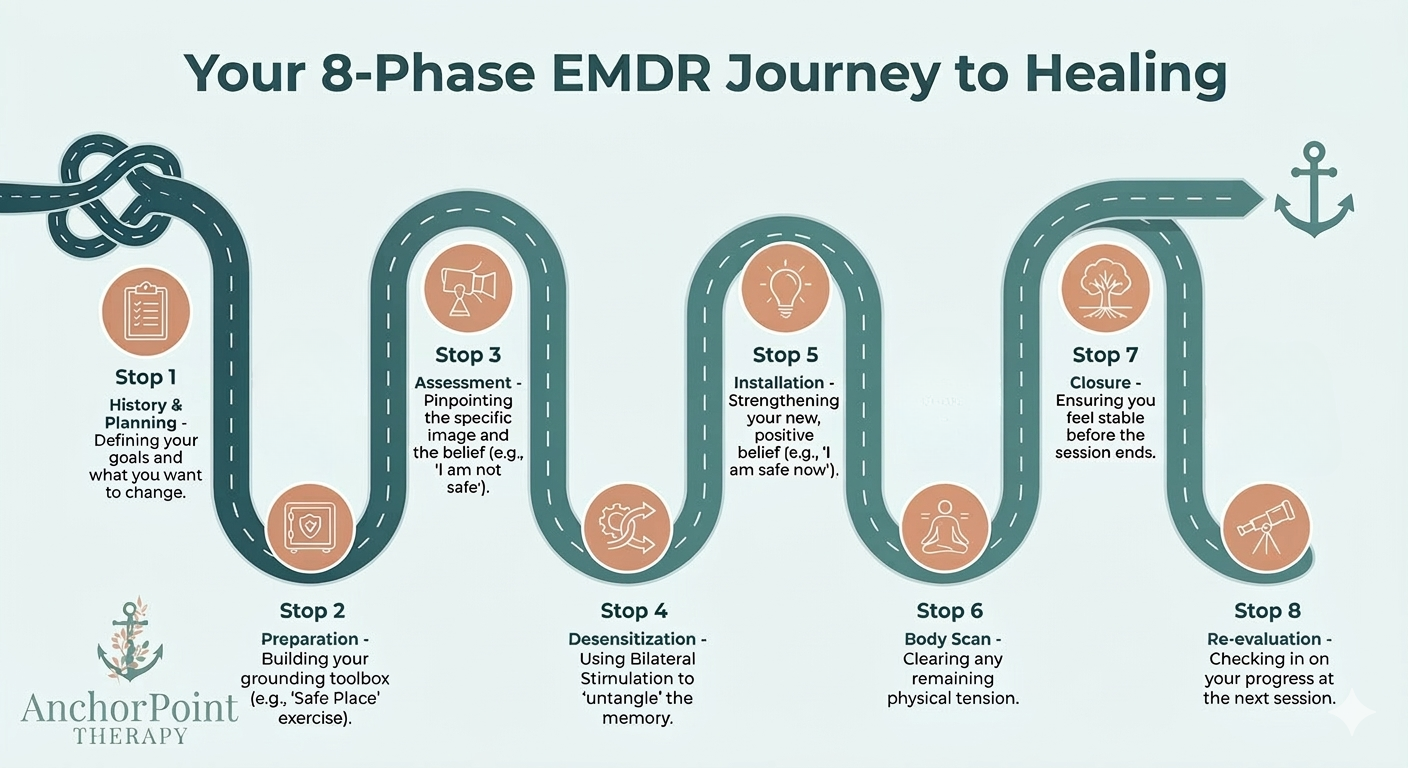
What are the 8 Phases of EMDR Therapy?
As mentioned above, we don’t just dive right into the hard stuff on day one. We follow a structured 8-phase process that prioritizes your safety and stability before we ever touch a difficult memory. Here is how we move from where you are now to where you want to be:
Let’s clear up what EMDR is NOT
Since we’re talking about “opening the box,” let’s set the record straight. There are a lot of myths about this process, but here is the reality of how we work together:
It’s NOT hypnosis: You are 100% awake, alert, and in the driver’s seat the whole time. You are always in control of the session; if you want to stop, we stop.
It’s NOT a "reliving" session: You don’t have to tell me every single painful detail for the therapy to work. Unlike some traditional talk therapies, we focus more on how the memory is affecting your body and your beliefs now, rather than getting lost in the "then."
It’s NOT erasing your memory: You’ll still remember what happened. The difference is that the memory will no longer have the power to hijack your heart rate or trigger a freeze response. It becomes a part of your story, not your current reality.
It’s NOT a "quick fix" that skips the prep: We don't dive into the deep end on day one. As a trauma-informed therapist, I ensure we spend time building your "coping toolbox" first. I won’t ask you to look at a difficult memory until we both feel confident that you have the tools to stay grounded.
EMDR Therapy FAQ
-
Yes. Research including randomized controlled trials and meta-analyses shows EMDR significantly reduces PTSD symptoms (Wright et al., 2024).
-
No. EMDR can also help with trauma-related anxiety, depression, phobias, and distressing memories.
-
Yes. A landmark study by McGowan et al. (2021) confirmed that online EMDR is just as effective as in-person therapy, with many clients feeling more in control in their own safe environment.
-
When delivered by a trained therapist, EMDR is considered safe and evidence-based (Shapiro, 2018).
-
The length of therapy varies depending on the individual and the concerns being addressed. Some people notice improvement within several sessions, while others benefit from longer-term therapy.
Ready to Start EMDR Therapy in Ontario?
If you’re ready to feel less overwhelmed and give your nervous system the "reset" it deserves, I’d love to help. You don’t have to stay stuck in survival mode, and you don't have to navigate the "opening of the box" alone.
I provide virtual EMDR therapy to women across Ontario, offering a secure and convenient way to do this deep work from the comfort of your own space.
Take the Next Step:
Book a Free Consultation: Let’s spend 15 minutes chatting about your goals and see if EMDR is the right fit for you.
Learn More: Explore my approach to Trauma Therapy and Pregnancy & Postpartum Anxiety.
Have Questions? Feel free to reach out via my Contact Page.
You deserve to feel as safe in your body as you are in your life. Let’s get started.
-
Bongaerts, H., Van Minnen, A., & de Jongh, A. (2021). Intensive Online EMDR Therapy for Patients with Complex Posttraumatic Stress Disorder.Journal of Anxiety Disorders.
McGowan, I. W., et al. (2021). The Efficacy of Eye Movement Desensitization and Reprocessing Therapy Delivered via Telehealth: A Rapid Review. Frontiers in Psychology.
Pagani, M., et al. (2012/2021 update). Neurobiological Changes in EMDR Therapy.(SPECT/fMRI Research on regional cerebral blood flow).
Registered Nurses’ Association of Ontario (RNAO). (2021). Clinical Best Practice Guidelines: Trauma-Informed Care.
Wright, L. A., et al. (2024). EMDR v. other psychological therapies for PTSD: a systematic review and individual participant data meta-analysis. Published in Psychological Medicine.
** Disclaimer: This article is for informational purposes only and does not constitute medical advice or a formal clinical diagnosis. Please consult with a qualified mental health professional to determine if EMDR is appropriate for your specific needs.